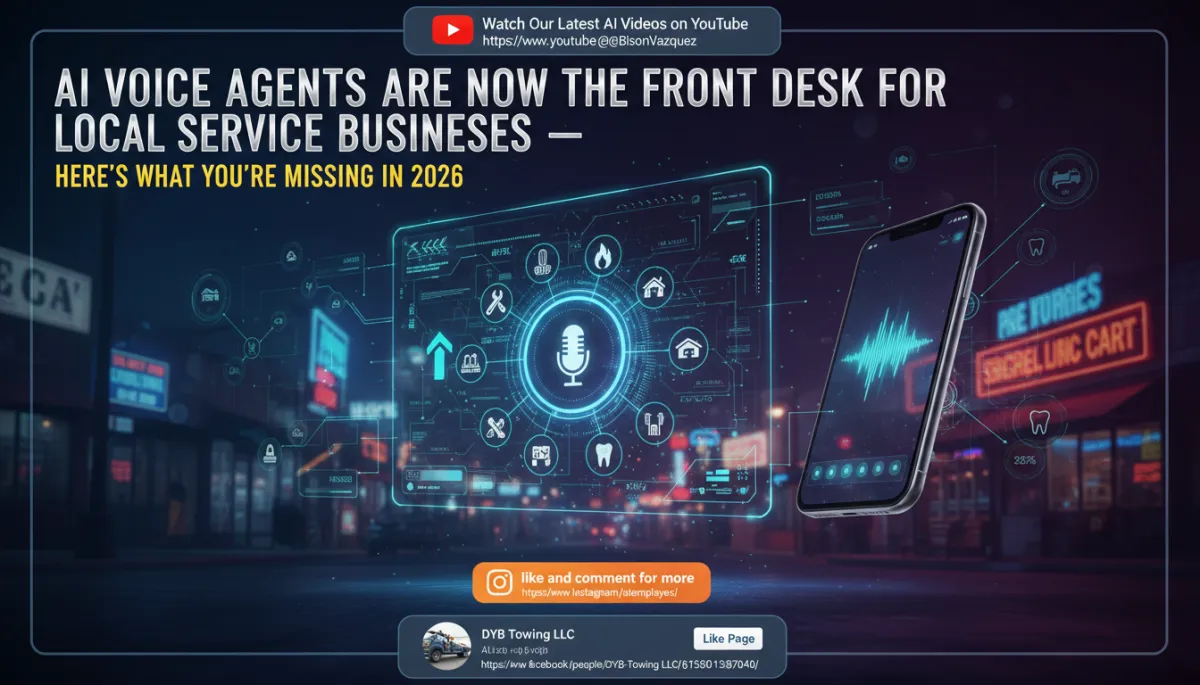
AI Voice Agents: The Future of Local Business
AI, Local Business, Automation, Phone Answering
AI Voice Agents Are Now the Front Desk for Local Service Businesses — Here’s What You’re Missing in 2026
If your phone rings after 5 p.m. and no one picks up, you’re already losing to the shop across town. In 2026, AI voice technology for local businesses has quietly turned into a ruthless competitive weapon — and the owners using it are taking your calls, your leads, and your repeat customers while you sleep.

The Missed Call Crisis Destroying Local Business Revenue
Let’s be blunt: every unanswered call is lost money. For HVAC, plumbing, roofing, auto repair, dental, towing, and restaurants, the phone is still the #1 way high-intent customers reach you. They’re not “browsing.” They’re ready to buy — right now.
Industry surveys show small service businesses miss between 20% and 40% of inbound calls, especially during evenings, weekends, and peak rush hours. That means up to 4 out of 10 potential jobs never even speak to a human. They hang up, call the next listing on Google, and your competitor’s AI voice agent answers instantly — friendly, confident, and ready to book.
In 2023, you could get away with voicemail. In 2026, voicemail is a revenue graveyard. Customers expect a real conversation, 24/7, with zero hold time. AI voice agent small business adoption has exploded because it solves the single biggest leak in your sales pipeline: calls that never convert into scheduled work.
What AI Voice Agents Can Actually Do in 2026 (It’s Way Beyond Basic Call Answering)
If you’re picturing a clunky IVR robot saying “press 1 for service,” you’re stuck in 2018. The new generation of AI front desk for service businesses runs on full-duplex, reasoning-capable models — the same kind of technology OpenAI, Google, and Amazon are rolling out for enterprise contact centers. They don’t just answer. They think, qualify, route, and close.
1. Real-Time Lead Qualification That Mirrors Your Best CSR
Modern AI voice technology for local businesses listens and speaks simultaneously, handling interruptions and back-and-forth just like a human. It can ask:
- “Are you calling about residential or commercial service?”
- “What’s the make and model of your unit/vehicle?”
- “Is this an emergency or can it wait until tomorrow?”
It then tags the call with job type, urgency, location, and budget range, and pushes that data straight into your CRM or job board. No scribbled notes. No lost details. Just clean, structured information your techs can act on immediately. According to TechRadar’s 2026 voice tech analysis, this kind of contextual awareness is now standard in leading systems, not a premium add-on.
2. After-Hours Booking That Actually Fills Tomorrow’s Schedule
The biggest shift in 2026 isn’t just answering calls at night — it’s booking real appointments while you sleep. Your AI voice receptionist connects to your live calendar, knows which techs or chairs are available, and can:
- Offer exact time slots (“We can do tomorrow at 8:30 a.m. or 11:15 a.m.”)
- Lock in bookings with confirmation numbers and directions via SMS
- Enforce your rules (no same-day crowns, emergency-only after 9 p.m., etc.)
Automated phone answering 2026 isn’t passive. It’s calendar-aware, policy-aware, and revenue-aware. That means fewer empty slots tomorrow and far fewer “call us back during business hours” dead ends.
3. Smart Price Negotiation Handling Without Discounting You to Death
You already know the script: “That seems high. Can you do any better?” A well-trained local business AI receptionist doesn’t panic or slash your margins. It’s programmed with your approved price ranges, minimums, and promo rules. It can:
- Explain value (“That includes parts, labor, and a 1-year warranty.”)
- Offer structured options (“We can do a diagnostic today and apply it to the repair.”)
- Use pre-approved discounts when appropriate (“First-time customers in your ZIP get $25 off service calls.”)
The result: more booked jobs at profitable rates, and far fewer leads lost because no one picked up to explain your pricing in the first place.
4. Hyper-Local, Neighborhood-Level Personalization
This is where 2026 AI voice agents pull away from generic call centers. Your AI can be trained on your city, your neighborhoods, your landmarks. It can say:
- “We’ve done a lot of work in the Oakwood Heights subdivision — those homes often have older furnaces.”
- “We can have a truck near the I-95 exit in about 20 minutes.”
It recognizes repeat callers, remembers their last service, and tailors responses accordingly. Gartner has pointed out that personalization is now a primary driver of customer satisfaction with AI assistants — and you can bring that same experience to your local market without hiring extra staff.
5. Call Routing and Automatic Follow-Up SMS That Closes the Loop
Your AI voice agent doesn’t work in isolation. It can route true emergencies to an on-call tech’s mobile, send a follow-up SMS with your address, quote, or payment link, and even trigger reminder texts before the appointment. This is where AI voice agent small business deployments are pulling ahead: they don’t just talk — they take action.
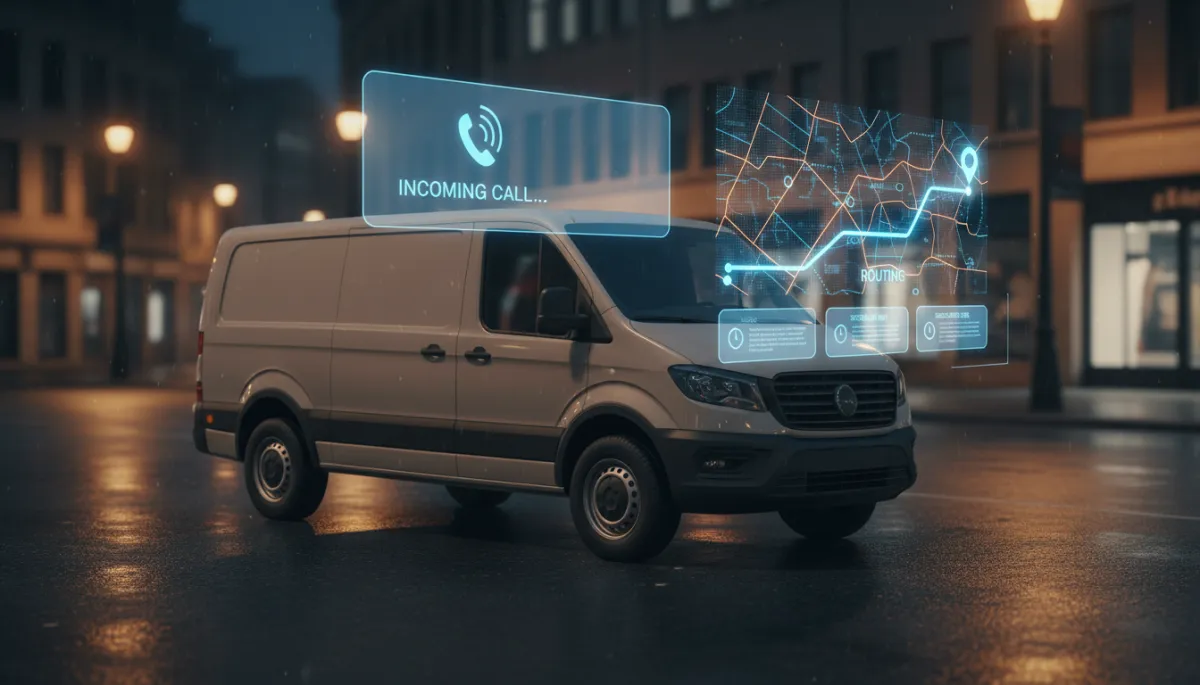
Night calls are no longer missed opportunities when AI routes and books jobs automatically.
The Local Businesses Already Winning With AI Voice
While you’re debating whether this is “too futuristic,” your competitors are already cashing in. Here’s how different trades are using AI front desk for service businesses right now:
- Towing: 24/7 AI agents answer roadside calls, capture exact location, vehicle type, and urgency, then dispatch the nearest truck. Result: fewer abandoned calls and faster response times.
- HVAC & Plumbing: AI screens out warranty and low-value calls, prioritizes no-heat/no-cool emergencies, and fills next-day slots with qualified, full-price jobs — increasing average ticket value.
- Roofing: Agents handle storm-night chaos, schedule inspections by neighborhood, and send SMS links for photo uploads so you can pre-qualify serious prospects before rolling a truck.
- Dental & Medical: AI books hygiene visits, screens emergency toothaches, confirms insurance details, and enforces cancellation policies — without burning out your front desk team.
Forbes and SmallBizTrends have both highlighted how AI voice assistants are transforming small business operations by handling routine interactions and freeing humans for higher-value work. The owners who moved early are now capturing more leads at lower staffing cost. Everyone else is playing defense.
Follow on Instagram — like and comment for moreHow to Deploy an AI Voice Agent in Under 48 Hours
This is not a six-month IT project. With the right platform, you can go from “nothing” to a fully functioning AI receptionist in two days. Here’s the high-level playbook:
- Map Your Call Types (2–3 hours). List your top 10 reasons people call: emergency repair, quote request, new patient, reschedule, order status, etc. This becomes the backbone of your AI conversation flows.
- Define Rules for Pricing and Scheduling (2 hours). Minimum trip fees, discount rules, service areas, on-call windows, and what counts as an “emergency.” Your AI follows these rules 100% of the time — no exceptions, no burnout.
- Connect Your Phone System (1–2 hours). Most AI platforms plug into VoIP systems or forward from your existing number. You can start with after-hours only, then expand to overflow and full-time coverage once you see results.
- Integrate Calendar and CRM (3–4 hours). Connect Google Calendar, Outlook, or your booking tool, plus your CRM or job management system. This powers real-time booking and automatic lead tracking.
- Test With Real Scenarios (half a day). Call your own number from different phones. Pretend you’re a panicked customer at midnight, a price shopper at noon, or a repeat client asking for the same tech. Refine scripts and rules based on what you hear.
By the end of this process, you’ll have an AI voice agent small business system that behaves like a trained employee — but never calls in sick, never goes on vacation, and never forgets to log a lead.
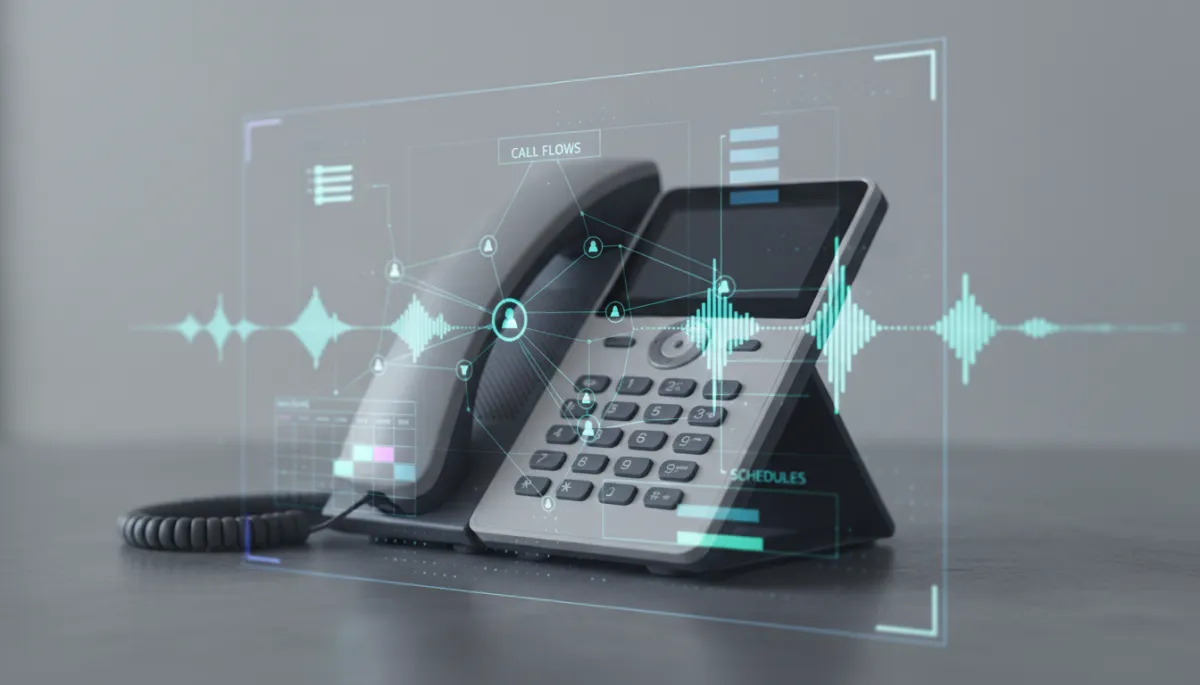
-toned close-up of a modern desk phone with visible voice-wave holograms and a transparent...
What to Look for in an AI Voice Platform (Non-Negotiables)
Not all AI front desk systems are built for local trades. When you evaluate platforms, demand these features — they’re the difference between a gimmick and a real competitive edge:
- Natural, interruption-friendly conversation. Full-duplex voice that can listen and talk at the same time, handle “uhh, wait, actually…” moments, and adapt mid-sentence — just like a sharp receptionist.
- Deep integrations with your tools. Calendar, CRM, dispatch, and payments. If it can’t book directly into your system, it’s just an expensive answering machine.
- Hyper-local configuration. Support for service areas, ZIP codes, neighborhoods, and custom scripts by location. You want it sounding like it knows your city, not like a generic call center.
- Clear analytics. Call volumes, booked jobs, conversion rates, missed opportunities, and revenue attributed to AI. If you can’t see the numbers, you can’t scale what’s working.
- Compliance and security. Call recording options, consent prompts where required, and strong data protection. Major vendors are doubling down on security because customers expect their data to be safe — your system should too.
Conclusion: Your Competitors Are Not Waiting — Neither Should You
The game has changed. In 2026, the “front desk” for winning local service businesses is no longer a single person behind a counter. It’s an AI front desk for service businesses that answers every call, qualifies every lead, handles price objections, books appointments, and personalizes conversations down to the neighborhood level — 24 hours a day.
Every night you delay, your competitors’ AI voice agents are quietly capturing the calls you miss. They’re building relationships with “your” customers, sending follow-up texts, and stacking their schedules with work that should have been yours. This isn’t hype — it’s the new baseline for serious operators who plan to still be in business, and thriving, three years from now.
You don’t need to become a tech expert. You need to make one decisive move: commit to replacing your fragile, human-only phone coverage with a local business AI receptionist that never sleeps, never misses a ring, and never forgets to close. Start with after-hours. Then overflow. Then full-time. But start now — because the businesses that own the phone in 2026 will own the market in 2027 and beyond.

When every call becomes structured data, scaling your local business gets predictable.
The choice is simple: let AI answer, qualify, and book your calls — or let it keep doing that for someone else.
