Boost Sales with Conversational AI for Small Business
Sales, Conversational AI, Small Business Growth
Conversational AI: How Smart Chatbots Are Closing More Sales for Small Business Owners
In 2026, the small businesses winning the sales game have one thing in common: they’ve quietly hired an AI sales assistant that never sleeps, never forgets a lead, and never misses a buying signal. This isn’t theory or Silicon Valley hype — it’s the new baseline for serious entrepreneurs who expect every marketing dollar to convert. If you’re still relying on contact forms and voicemail, you’re leaving money on the table every single day.

What Conversational AI Really Is in 2026 (And Why It’s Not “Just a Bot”)
Conversational AI for business in 2026 is far beyond the clunky chat widgets you saw a few years ago. Today’s systems are agentic, multimodal sales machines that can understand natural language, switch between voice and text, remember context, and trigger real actions in your CRM, calendar, and payment tools — all in seconds. Gartner projects that by 2026, 40% of enterprise applications will include task‑specific conversational AI agents, up from under 5% just a year ago, and that same technology is now accessible to small businesses at a fraction of the cost.
The global conversational AI market is already worth around $17.7 billion and is on track to hit nearly $79 billion by 2033, growing at over 23% annually. That growth is driven by one simple fact: these AI systems make and save serious money. Industry data from 2026 shows chatbots handling 70–85% of routine queries, cutting support costs by up to 50% while lifting conversion rates by 20–35%. In plain English: more sales, fewer staff hours, and a dramatically more efficient funnel.
Florida-based conversational AI strategist Bison Vazquez — “The AI Guy,” known locally as The Local AI Guy for Florida — puts it bluntly: “If your website or social feeds don’t have an AI sales assistant working 24/7 in 2026, you’re not just behind — you’re invisible when it matters.” His clients aren’t chasing hype; they’re using conversational AI to do one thing relentlessly well: turn conversations into cash flow.
How Smart Chatbots Qualify Leads 24/7 While You Sleep
The old model was simple and brutally inefficient: a prospect fills out a form, waits hours (or days) for a reply, and in the meantime, your competitor answers them instantly and wins the deal. Harvard Business Review has shown that companies responding within five minutes are 21× more likely to qualify a lead than those who wait 30 minutes. Your human team cannot compete with that — but your AI sales assistant can respond in under three seconds, every time, at any hour, on any channel.
Modern AI chatbots for sales behave like disciplined SDRs (sales development reps). They greet visitors, ask smart qualifying questions, and route only the best opportunities to you or your team. For a typical chatbot small business deployment, the bot can automatically:
- Identify whether a visitor is a serious buyer, price shopper, or existing customer needing support.
- Capture email, phone, and intent (“buy today,” “compare options,” “need a quote”) without friction.
- Book appointments or demos directly into your calendar with time‑zone awareness and reminders.
- Escalate hot leads to live chat, SMS, or phone when a human closer is needed.
For a small local service business handling 500 inquiries per month, research shows that a well‑configured AI chatbot can capture around 140 extra qualified leads after hours alone. At a conservative 10% close rate and $200 average sale, that’s roughly $2,800 in extra monthly revenue — from conversations you were previously ignoring. This is AI chatbot lead generation in its purest, most profitable form.
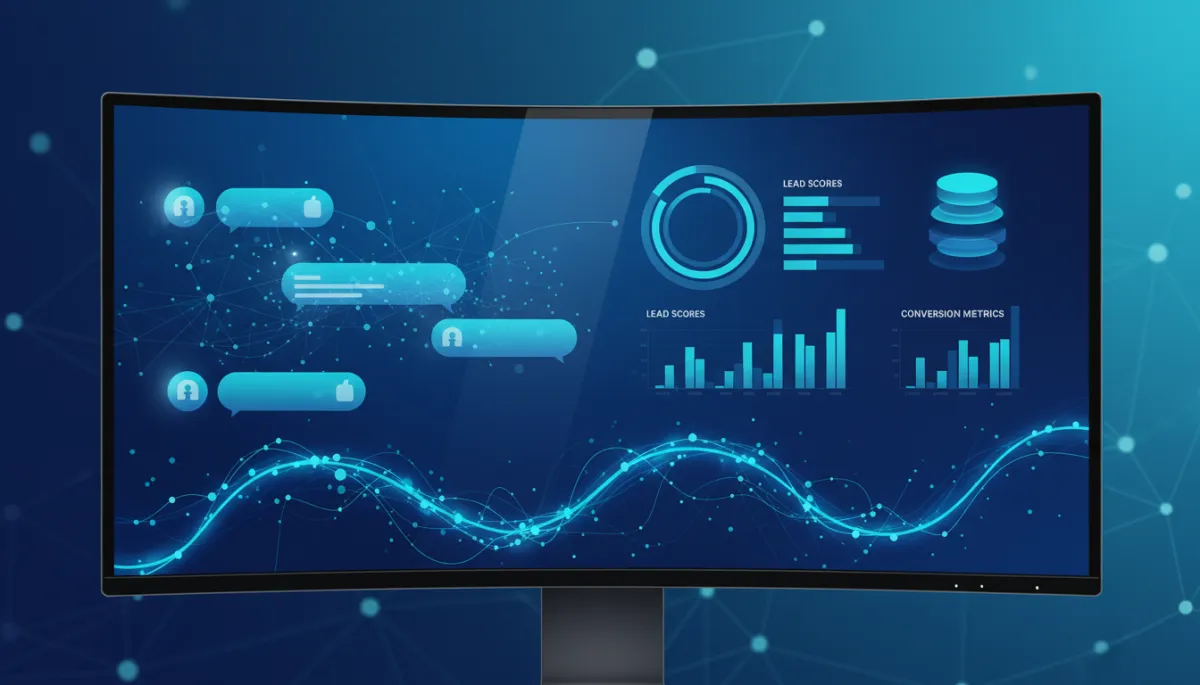
Always-on chatbots qualify, score, and route leads long before humans log in.
Chatbot Scripts That Actually Close Sales — Not Just “Answer Questions”
Most small businesses make one fatal mistake: they treat their chatbot like a glorified FAQ page. In 2026, that’s unacceptable. AI chatbots for sales must be scripted and trained to sell, not just talk. That means designing conversations that move a visitor from curiosity to commitment using proven, high‑intent flows — and then letting the AI personalize every step in real time.
Effective sales chatbots use three core script patterns:
- Problem–Agitate–Solve: The bot identifies the pain (“struggling to keep up with customer calls?”), deepens urgency (“missed calls often mean missed revenue”), and presents your offer as the solution (“we can install same‑day towing or HVAC service with guaranteed response times — want a quote now?”).
- Guided Choice: Instead of asking, “How can I help?” the AI offers curated paths: “Are you here to book a service, get pricing, or talk to a specialist?” Each path has its own micro‑script designed to end in a booking, payment, or scheduled call.
- Risk‑Reversal Close: When a buyer hesitates, the bot leans on guarantees, testimonials, and urgency: “Most customers in your area book within 24 hours to lock in availability. You can cancel up to 12 hours before with no fee. Want to reserve your spot for tomorrow at 10am?”
Bison Vazquez routinely deploys AI sales assistants that mix these script patterns with your actual sales data, FAQs, and customer reviews. The result is a bot that sounds like your best closer on their best day, every day. If you want a shortcut, you can get inside the AI Secrets Challenge and deploy your first AI sales chatbot this week instead of spending months guessing at scripts that may never convert.
🔥 Want Daily AI Tips That Actually Move the Needle?
Follow @aiemployers on Instagram — Like & Comment for More!Integrating Chatbots With Your CRM and Sales Funnels for Maximum Leverage
A chatbot that lives in isolation is a toy. A chatbot wired into your CRM, email platform, and sales funnel is an asset that compounds. The real power of conversational AI for business appears when every interaction automatically enriches your database, triggers follow‑ups, and feeds your pipeline with context‑rich opportunities your team can close faster and at higher ticket values.
In a modern setup, your AI sales assistant doesn’t just chat — it:
- Pushes every qualified lead directly into your CRM (HubSpot, GoHighLevel, Salesforce, etc.) with tags like “hot,” “warm,” “cold,” plus key notes on budget, timeline, and objections.
- Triggers automated email or SMS sequences tailored to the exact conversation they just had, not a generic blast.
- Syncs with your booking tools so that scheduled calls, demos, or site visits instantly show on your calendar with reminders and reschedule links.
- Sends alerts to your team when a high‑value prospect is live on the site or re‑engaging after a previous conversation.
This is where the 2026 shift toward agentic systems becomes real for small businesses. Your chatbot is no longer a single “bot”; it’s the front end of an orchestrated system that talks to your inbox, your funnel pages, your ad campaigns, and your analytics. Done correctly, every click, message, and call is tracked, attributed, and optimized — giving you hard numbers on conversational AI ROI instead of vague “engagement” metrics.

Integrated AI funnels track every step from first chat to closed invoice.
ROI Case Studies and Conversion Stats: What Small Businesses Are Actually Seeing
Let’s talk numbers, because in 2026, CFOs and owners are done with “cool demos.” They want proof. Across industries, chatbots are now handling 70–85% of routine questions, freeing teams to focus on high‑value conversations. Support costs drop by 30–50%, while sales conversions rise by 20–35% — with best‑in‑class deployments hitting up to 50% conversion lifts and first‑year ROI in the 200–500% range, sometimes even higher for high‑volume businesses.
Consider a small towing company doing $35,000 per month in revenue. Before conversational AI, they were missing late‑night calls and relying on voicemail. After deploying an AI sales assistant scripted and configured by an expert like Bison Vazquez, they:
- Captured an extra 80–100 jobs per month via chatbot and SMS, mostly after hours.
- Increased average ticket size by 12% through smart upsells (premium towing, storage, priority service).
- Paid back their chatbot investment in under four weeks and saw a 300%+ ROI in year one.
These outcomes aren’t outliers. Industry‑wide, reports show first‑year chatbot ROI between 200–500%, with some deployments reaching 5,000% in extremely high‑volume environments. Broader AI in sales is driving a 13–15% revenue lift and 10–20% improvement in overall sales ROI. And importantly, 74% of organizations now report measurable AI ROI within the first year, often seeing 3–6× returns on their initial investment.
For small business owners and entrepreneurs, the message is clear: conversational AI is no longer an experiment. It’s a proven revenue engine. The only real question is whether you’ll deploy it strategically — with tight scripts, CRM integration, and expert oversight — or watch competitors who do so quietly out‑convert you month after month.
Your Next Move: Turn Conversations Into a Predictable Sales Machine
By 2026, conversational AI for business is table stakes, not a novelty. Voice, chat, and multimodal AI are built into everything from Google’s Gemini to Amazon’s Alexa+ shopping flows. The giants have already trained your customers to expect instant, intelligent responses — and they bring that expectation to your website, your Instagram DMs, your Facebook page, and your SMS threads. If you don’t meet that standard, someone else will.
As The Local AI Guy for Florida, Bison Vazquez sees the same pattern again and again: the moment a small business plugs in an AI sales assistant, lead leakage drops, follow‑up improves, and revenue stops being so “lumpy.” Instead of hoping the phone rings, owners can see a clear, measurable pipeline driven by AI chatbots for sales that qualify, nurture, and close around the clock. That’s not a futuristic dream — it’s what disciplined operators are already doing quietly in your market.
If you’re serious about scaling revenue without bloating payroll, your next strategic hire should be an AI sales assistant that plugs directly into your funnels, CRM, and follow‑up systems. Don’t wait until your competitors have already trained the market; move first, claim the advantage, and let data‑driven conversational AI prove its worth in your numbers, not just your imagination.
