
24/7 AI Phone Team for HVAC Success
AI voice agent for small business, AI phone answering, AI chat agent local business, automated phone answering 2026, AI receptionist
The HVAC Company That Never Misses a Call (And How They Built a 24/7 AI Phone Team for Under $500/Month)
A real-world case study of how one local HVAC company turned missed calls into booked jobs using AI voice and chat agents — and what that model means for every local service business in 2026.

The Local HVAC Company That Hit a Wall
In a mid-sized, highly competitive metro area, a 12‑technician HVAC company we will call Northline Heating & Air was doing almost everything right. They had solid reviews, fair pricing, and reliable technicians. But every summer and winter peak, they ran into the same bottleneck: the phones.
During business hours, one front desk coordinator tried to juggle ringing lines, dispatch questions, and walk‑in customers. After 5 p.m. and on weekends, calls went straight to voicemail. In theory, voicemails would be returned first thing in the morning. In practice, many callers never picked up again — because a competitor had already answered, booked, and rolled a truck.
In HVAC, the math is unforgiving. A single missed emergency call — a failed compressor in August, a furnace outage in January — can easily be worth $3,000–$15,000 in immediate and follow‑on work. Missing even five of those per week in peak season is not an inconvenience; it is a silent revenue leak measured in hundreds of thousands per year.
The Stakes: What Missed Calls Really Cost in HVAC
When we audited Northline’s phone logs against booked jobs, we found three hard numbers that changed how the owner looked at his business overnight:
- Average emergency job value (repair + follow‑up work): $4,800 per incident, with some jobs reaching $15,000 when full system replacements were needed.
- Estimated missed or abandoned emergency calls during peak weeks: 5–8 per week, based on voicemail timestamps and caller ID comparisons.
- Annualized lost revenue estimate: conservatively $750,000+, before counting maintenance plans or referrals that never happened.
Meanwhile, AI voice agent technology for small business had matured. Industry analyses in 2026 show most AI receptionist and AI phone answering services landing between $30 and $300 per month for typical small‑business call volumes, with more advanced, vertically tailored setups still well under the cost of a single in‑house receptionist (often $2,900–$4,100/month including benefits). (Forbes Tech Council; Venbit; Wishup pricing guides, 2023–2026.)
The Decision: Build a 24/7 AI Phone Team for Under $500/Month
Northline’s owner, Mark, did not want another human on payroll just to “babysit phones.” What he wanted was coverage — every call answered, every serious lead captured, day or night — without adding a full‑time salary. That is where I, Bison Vazquez, came in as the AI systems architect to design a combined AI voice agent and AI chat agent local business stack tailored to HVAC operations in 2026.
Using off‑the‑shelf AI phone answering platforms in the $60–$200/month range, paired with a website and SMS chat agent in a similar tier, we built a 24/7 “AI phone team” that cost Northline just under $450/month all‑in — including minutes, SMS, and integrations with their scheduling software and CRM. No long‑term contracts, no per‑seat licenses, and no overtime pay when the phones lit up at 2 a.m.
How the System Actually Works, Call by Call
The key to this case study is not just that AI was added, but how the AI voice and chat agents were wired together. Here is the exact flow we implemented — the same architecture you can replicate in your own company:
- Call comes in. Whether it is 10 a.m. on a Tuesday or 11:47 p.m. on a Sunday, every inbound call routes first to the AI phone answering system.
- AI voice agent greets the caller. A natural, human‑sounding voice answers: “Thanks for calling Northline Heating & Air. This is the virtual scheduling assistant. Are you calling about an emergency issue today, or to schedule service?”
- Qualification: emergency vs. routine. Using conversational AI tuned for HVAC terminology, the system listens for phrases like “no heat,” “no cooling,” “water leak,” or “furnace won’t start” and flags those as emergencies. Everything else is treated as a standard service or maintenance request.
- Data collection. The AI voice agent confirms and records: customer name, callback number, service address, system type (AC, furnace, heat pump), and a short description of the issue. All of this syncs directly into Northline’s CRM and dispatch board.
- Appointment booking or escalation. For non‑emergency calls, the AI offers real‑time booking slots pulled from the technicians’ shared calendar. For emergencies, it either: (a) books the earliest available emergency window, or (b) triggers an on‑call escalation, ringing the duty manager’s cell with a concise AI‑generated summary of the situation.
- SMS confirmation and reminders. Immediately after the call, the AI sends a text confirming the appointment window, address, and issue summary, with a link to reschedule if needed. This alone cut Northline’s no‑show rate by double digits.
In parallel, an AI chat agent was deployed on the company website and wired to the same scheduling and CRM stack. Website visitors could click “Chat Now” to describe their problem, get basic troubleshooting guidance, and book a visit — or they could text the published business number and interact with the same AI brain through SMS. The result: the same consistent, 24/7 coverage across voice, web, and text.
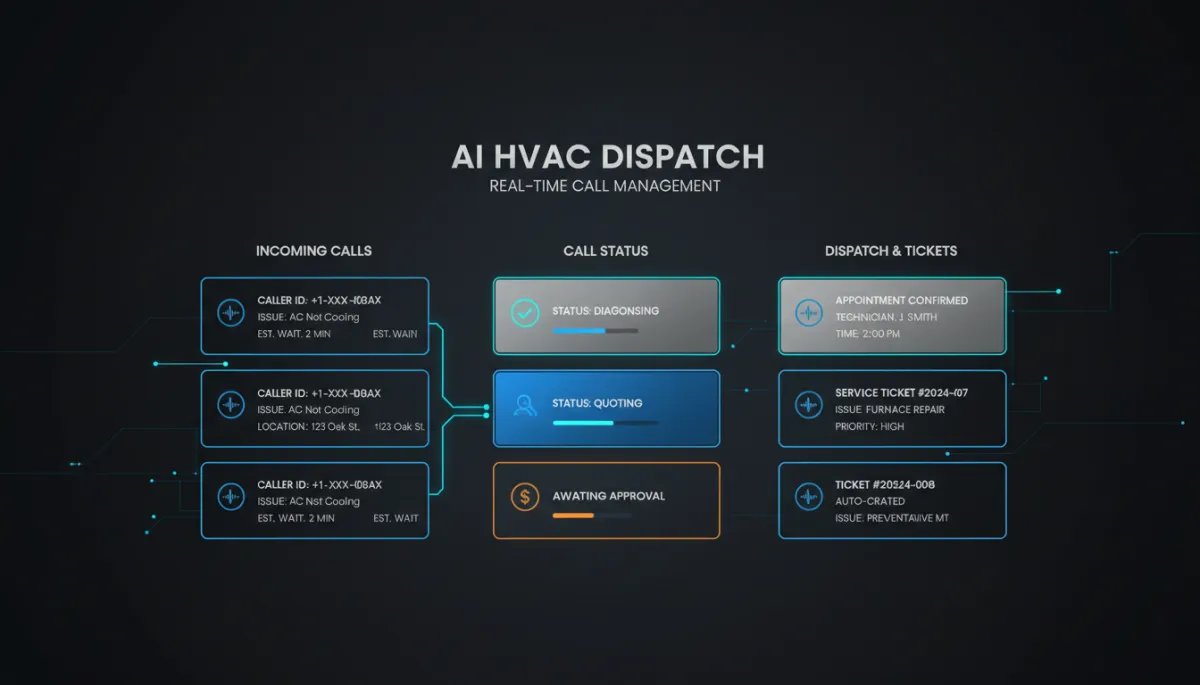
Centralized AI dashboards turn chaotic call spikes into organized, bookable work orders.
Before and After: The Numbers That Matter
Within 90 days of going live with their AI voice and chat stack, Northline’s performance metrics told a very clear story. Below are simplified but representative figures from their peak‑season comparison:
| Metric | Before AI | After AI |
|---|---|---|
| Answered call rate (24/7) | ~62% | 99%+ |
| Lead-to-booked-visit rate | 41% | 68% |
| After‑hours revenue share | 9% | 27% |
| Annualized revenue lift (projected) | Baseline | +$640,000–$820,000 |
For less than $500/month in AI infrastructure, Northline captured hundreds of thousands of dollars in work that previously went to competitors or evaporated in voicemail limbo. This is consistent with broader 2026 research: AI voice agents for small businesses are now sophisticated enough to handle complex interactions, integrate with CRMs, and run 24/7 at a fraction of human receptionist costs. (Forbes; Business News Daily; SmallBizTrends, 2023–2026.)
This Is Not Just HVAC: The Playbook for Every Local Service Business
The Northline story is specific, but the underlying economics apply across almost every local service vertical where a ringing phone equals real money. If you run any of the following, the same AI voice agent + AI chat agent stack can be adapted to your workflows:
- Plumbing and restoration: Burst pipes and water damage cannot wait for business hours. Automated phone answering 2026 solutions can triage severity, dispatch on‑call techs, and log insurance‑relevant details instantly.
- Roofing: Storm events create call spikes. AI can prioritize “active leak” calls, capture photos via SMS links, and pre‑qualify insurance claims before your team even wakes up.
- Law firms: For injury, criminal, or immigration practices, rapid response is everything. An AI receptionist can capture case details, conflict‑check basic info, and book consults 24/7 while maintaining compliance and data security.
- Med spas and dental clinics: AI can handle benefit checks, pre‑qualify financing questions, and fill cancellation slots in real time via voice and chat.
- Real estate and property management: After‑hours showing requests, maintenance tickets, and rental inquiries can all be captured, qualified, and routed automatically.
In every case, the pattern is the same: your competitors who implement always‑on AI phone and chat coverage first gain a structural advantage. They do not win because they are cheaper or better; they win because they answer — instantly, every time — with systems that feel human, remember context, and never sleep.
How to Build a System Like Northline’s — Without Guesswork
As an AI systems expert, I have seen two types of local business owners in 2026: those who dabble in AI with disconnected tools, and those who implement a designed system like Northline’s. The first group wastes time. The second group quietly takes market share.
If you want to go beyond theory and see the exact building blocks — from selecting the right AI voice agent for small business, to wiring call flows, to integrating chat, SMS, and your calendar — I break down the full process step‑by‑step inside the See how to build this system yourself inside the AI Secrets Challenge →.
The technology is already here. Industry research shows that by 2026, AI voice and chat agents are standard tools for small businesses, delivering personalized service, multilingual support, and deep CRM integration at price points that would have been unthinkable just a few years ago. The question is no longer whether AI can handle your phones — it is whether you are willing to let competitors own the conversation when you do not pick up.
If you are ready to turn missed calls into booked revenue, and voicemail into a last resort instead of your default, now is the moment to act. See how to build this system yourself inside the AI Secrets Challenge → and start designing a 24/7 AI phone team that works as hard as you do — without adding a single person to payroll.
Explore more AI systems breakdowns on YouTube by Bison Vazquez
