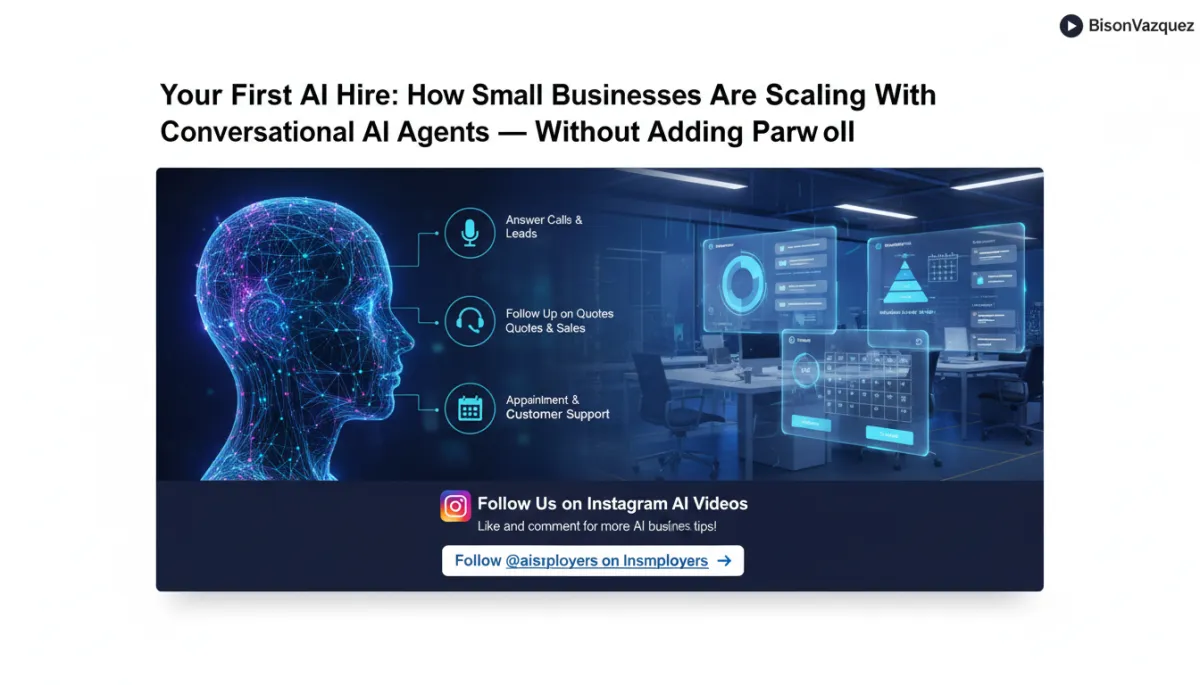
Scale Your Business with AI Agents, No Payroll Needed
▶️ Watch Our Latest AI Videos on YouTube
Watch Now on YouTube →AI hiring, conversational AI for small business, AI agents for business
Your First AI Hire: How Small Businesses Are Scaling With Conversational AI Agents — Without Adding Payroll
Conversational AI for small business is no longer a Silicon Valley experiment. It is a practical hiring decision that lets you add a tireless “employee” who answers every call, follows up every lead, and books every appointment — without ever showing up on your payroll.

Why Your “First AI Hire” Belongs on the Front Lines in 2026
In 2026, small business automation is not optional; it is competitive survival. Federal Reserve data shows that between 20% and 40% of small businesses had already adopted AI tools by 2024, and that number is climbing fast as platforms become easier and cheaper to deploy (FRBSF, 2026). Intuit’s 2026 AI Impact Report found that more than three in four small and midsize businesses now use AI regularly — and they are reporting higher productivity, more revenue, and even more hiring, not less.
The smartest owners are no longer asking, “Should I hire?” They are asking, “What should my first AI hire do for me?” That first AI hire is almost always a conversational AI agent — a voice or chat assistant that talks to your customers like a real person, 24/7, across phone, text, web chat, and social DMs. It never sleeps, never calls in sick, and never forgets to follow up on a quote.
This is the emerging AI workforce 2026: small businesses deploying conversational AI for small business as a front-line “employee” that absorbs repetitive, time-sensitive tasks so humans can focus on higher-value work and growth. Census data shows that 66% of firms using AI use it to augment tasks, with only 2% reporting job reductions. In other words, AI is a force multiplier, not a pink slip.
What Conversational AI Agents Actually Do for Small Businesses
Forget the hype. Let’s get concrete. AI agents for business are specialized conversational systems trained on your offers, pricing, FAQs, and workflows. They plug into your phone system, website, and CRM to handle specific, revenue-critical tasks:
- Answer inbound calls and chats 24/7: When a prospect calls at 9:30 p.m., your AI agent picks up, qualifies the lead, answers common questions, and captures all contact details — without voicemail limbo.
- Respond to leads instantly: The agent replies to web forms, Facebook messages, and text inquiries within seconds, not hours. That speed alone can double your close rate in some industries.
- Book and manage appointments: Integrated with your calendar, the AI offers real-time availability, confirms bookings, sends reminders, and reschedules when customers text, “Can we move it to Friday?”
- Follow up on quotes and estimates: Instead of you chasing every quote, the AI checks in automatically: “Did you have any questions about your estimate?” That gentle nudge converts forgotten quotes into closed deals.
- Handle routine support questions: Hours, pricing ranges, service areas, warranty details, return policies, basic troubleshooting — your AI agent answers all of it consistently, freeing your team from repetitive calls and emails.
Because modern conversational AI uses advanced natural language processing, it is far beyond the clunky bots of 2019. It understands context, remembers details within a conversation, and can escalate to a human when needed. That is why conversational AI for small business has moved from “nice-to-have” to “how are you still not using this?” territory.

A single conversational AI agent can orchestrate calls, chats, and bookings across your entire funnel.
Real Cost Comparison: AI Agent vs. Part-Time Employee
Let’s talk numbers, because AI hiring is ultimately a financial decision. Imagine you want coverage for phones, follow-up, and scheduling during evenings and weekends — the times you are currently missing calls and losing leads.
The Part-Time Employee
- $18/hour for 20 hours per week ≈ $1,560/month before taxes.
- Payroll taxes, workers’ comp, and potential benefits can easily push that to $1,900–$2,100/month.
- Add onboarding, training time, supervision, turnover risk, and scheduling headaches.
The Conversational AI Agent
- Typical small business plans range from $300–$800/month, depending on volume and integrations.
- No payroll taxes, no benefits, no overtime, no sick days, no turnover.
- Coverage is 24/7/365, not just 20 hours per week.
Research from McKinsey and Harvard Business Review consistently shows that while AI has some upfront implementation cost, ongoing operational costs are dramatically lower than human labor for repetitive, process-driven tasks. Once deployed, an AI agent can handle hundreds of conversations per day without incremental cost, something no part-time employee can match. Over a year, that can mean four-figure savings and dramatically higher lead capture — a powerful one-two punch.
📸 Follow Us on Instagram
Like and comment for more AI business tips!
Follow @aiemployers on Instagram →How to Onboard Your First AI Agent in Under a Week
Deploying AI agents for business is far easier than most owners realize. You do not need a data science team or a six-figure budget. Follow this decisive, one-week rollout plan:
Day 1: Define the Job Description
- Decide the AI agent’s primary role: inbound calls, lead follow-up, appointment scheduling, or support — then rank them.
- List the top 20 questions customers ask and the ideal answers in your own words.
Day 2–3: Choose and Connect the Platform
- Select a conversational AI for small business platform that integrates with your CRM, calendar, and communication channels (phone, SMS, web chat, social).
- Connect your calendars and import basic customer and lead data so the AI can personalize interactions and avoid double-booking.
Day 4–5: Train the Agent on Your Business
- Upload your FAQs, pricing sheets, service descriptions, and policies. Most modern systems support simple document uploads or knowledge bases.
- Configure scripts for greetings, qualification questions, and handoff rules (for example, “If the customer asks about custom contracts, transfer to owner.”).
Day 6: Test, Break, and Refine
- Have your team “mystery shop” the AI via phone, chat, and SMS. Ask tricky questions. See where it hesitates or answers vaguely.
- Tweak answers, add missing information, and tighten escalation rules based on those test conversations.
Day 7: Go Live — with Guardrails
- Turn the AI on for selected channels or time windows first (for example, after-hours calls and website chat).
- Review transcripts daily for the first week. Make small adjustments. Within days, you will see patterns — and profits — emerge.
A focused, one-week onboarding plan turns AI from theory into a working team member.
Common Mistakes When Deploying AI — and How to Avoid Them
Mistake #1: Treating AI as a Gadget, Not a Hire
Owners sign up for a tool, click around, and then abandon it because there is no clear role or success metric. Instead, treat your AI like a real employee: give it a job title, KPIs (calls answered, appointments booked, response time), and a manager responsible for its performance.
Mistake #2: Turning It Loose Without Guardrails
AI is powerful, but it is not omniscient. Let it handle well-defined, low-risk tasks first, and set strict escalation rules for anything involving pricing exceptions, legal commitments, or sensitive information. This protects your brand while you learn what your AI workforce 2026 can truly handle.
Mistake #3: Ignoring Data, Guessing About ROI
Many owners “feel” like the AI is or is not working but never check the numbers. Track missed calls before and after, appointment volume, conversion rates from leads to sales, and time saved by your team. Bluevine’s 2026 report shows only 52% of owners currently see clear ROI from AI — often because they never defined what ROI should look like. You are not going to be one of them.
Mistake #4: Neglecting Security and Compliance
Your AI agent will handle customer names, phone numbers, maybe even payment or health-related details. Choose vendors with clear security standards, encryption, and compliance options. Ask where data is stored, who can access it, and how long it is retained. Strong security is not a luxury; it is table stakes for serious small business automation.
The Bottom Line: Start Building Your AI Workforce Today
The data is clear: small businesses that adopt AI early are seeing faster growth, higher productivity, and stronger competitiveness. Goldman Sachs reports that 93% of AI-using small businesses see positive impact, with 87% saying AI augments rather than replaces their people. Your first AI hire is not about cutting jobs — it is about unlocking capacity you currently do not have.
If you are serious about scale, you cannot afford to keep missing calls, losing leads, and burning hours on repetitive tasks that a well-trained conversational AI agent can handle flawlessly. The owners who win the next three years will be the ones who treat conversational AI for small business as a strategic hire, not a trendy app.
Decide today: What will your first AI hire own — sales follow-up, customer support, or appointment scheduling? Choose one, commit to a one-week onboarding sprint, and put an AI agent on the front lines of your business. While your competitors are still debating AI, you will be quietly capturing every lead, every call, and every opportunity — without adding a single dollar to payroll.
👍 Connect With Us on Facebook
Visit Our Facebook Page →